Chicago Architecture Spotlight: Wolf Point
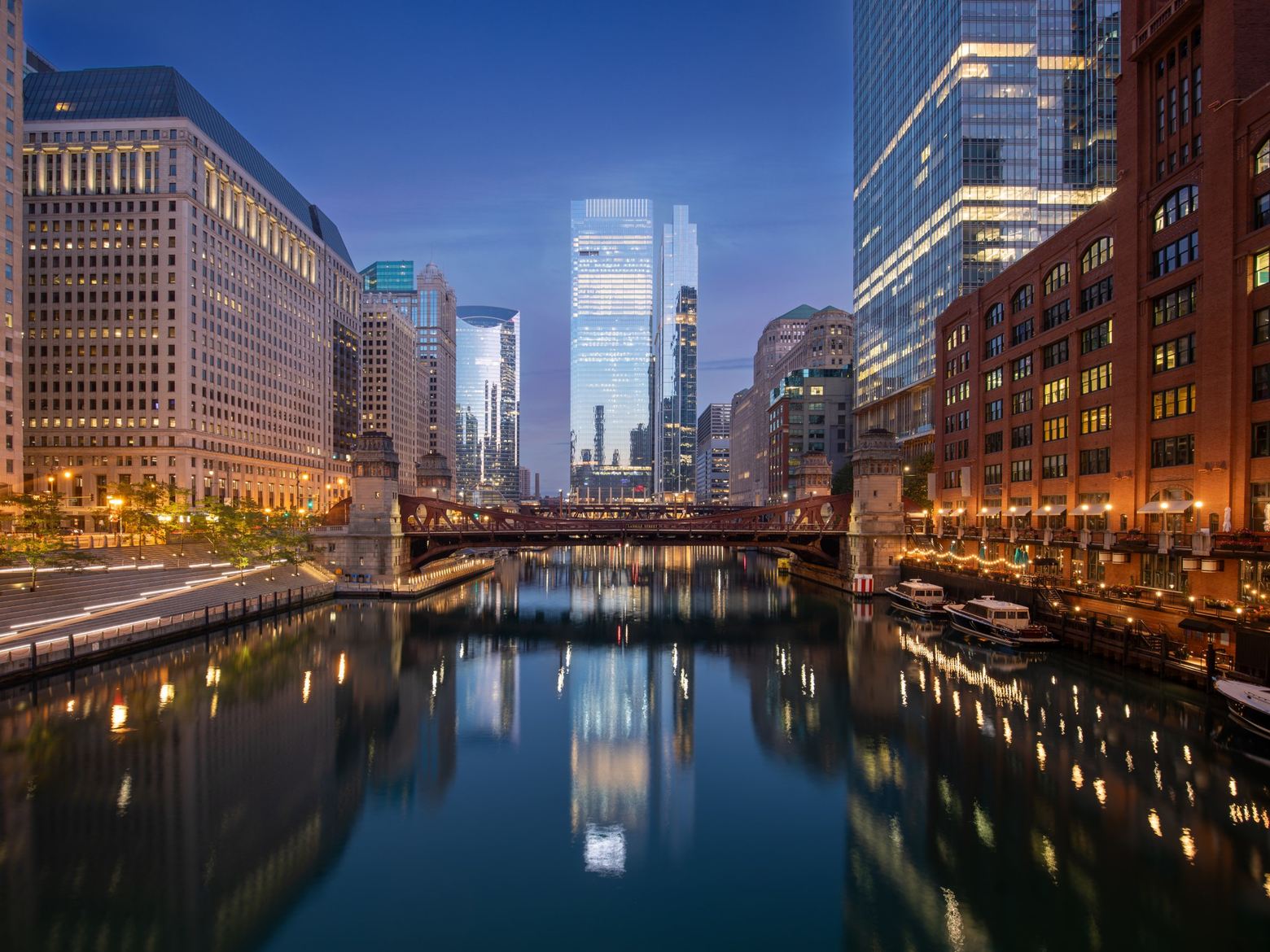
Wolf Point is the spot where the North, South, and Main branches of the Chicago River meet, about 1.6 miles west of Lake Michigan. It was the center of Chicago’s earliest development: the site of the city’s first taverns, first hotel, first ferry, first church, and first bridges across the river. Today, Wolf Point is home to three modern towers completed between 2016 and 2023, including Salesforce Tower Chicago, along with a riverfront park at a site that played a central role in the city’s early history.
Most Chicago landmarks are single buildings. Wolf Point is a place, the Y-shaped fork in the river where early Chicago took shape. This Chicago Architecture Spotlight from Shoreline Sightseeing covers Wolf Point’s history, the towers that define it today, and why it’s such a rewarding stop on a river tour.
Wolf Point at a Glance
- Landmark
- Wolf Point
- First Tavern
- 1828
- What It Is
- The confluence of the North, South, and Main branches of the Chicago River
- Location
- Where River North, the Loop, and the Near West Side meet, about 1.6 miles west of Lake Michigan
- Historic Firsts
- Chicago’s first taverns, hotel, ferry, drug store, church, theater company, and river bridges
- Modern Towers
- Wolf Point West (2016), Wolf Point East (2020), Salesforce Tower Chicago (2023)
- Public Space
- A 2.3-acre riverfront park and an extension of the Chicago Riverwalk
- Civic Symbol
- Inspired Chicago’s Y-shaped Municipal Device
History of Wolf Point
The Center of Early Chicago
Chicago’s first permanent non-Native settler, Jean Baptiste Point du Sable, built his home near the mouth of the river, close to today’s Michigan Avenue and Pioneer Court area. But as the settlement grew, the fork in the river upstream became its natural crossroads. Traders and travelers met here, and the town’s first businesses followed. In 1828, the first tavern opened on the west bank at Wolf Point. Within a few years, the area was home to Chicago’s first three taverns, its first hotel, its first ferry, its first drug store, its first church, its first theater company, and the first bridges across the river.
The Sauganash Hotel and Early Civic Life
Chicago’s first hotel, the Sauganash, opened in 1831 at the fork, on the corner that later became Lake and Market streets. When Chicago was incorporated as a town in 1833, its first elections were held there, and many early town meetings took place under its roof. Decades later, the Wigwam, where Abraham Lincoln won the Republican presidential nomination in 1860, was built at the same site.
How Wolf Point Got Its Name
The origin of the name is uncertain. Juliette Kinzie’s 1856 memoir says the point was named for a local resident known as Moa-way, or “the Wolf.” Other stories credit a tavern keeper who hung a painted wolf sign outside his door, or soldiers who noticed wolves gathering there at night. The name originally referred to the west bank at the fork. Over time it came to mean the whole area, and today it most often describes the triangle of land on the north bank.
From Frontier Hub to Parking Lot
As Chicago grew, the river became an industrial corridor, and Wolf Point’s role as the city’s center faded. The north bank parcel, long owned by the Joseph P. Kennedy family, went unbuilt for decades and served as a surface parking lot. Redevelopment plans surfaced as early as the late 1980s, and updated three-tower plans proposed in 2012 finally moved forward, with construction beginning in 2014.
Wolf Point and the Chicago Flag
The river branches that meet at Wolf Point also appear on the Chicago flag. Its top blue stripe represents Lake Michigan and the North Branch, and its bottom blue stripe represents the South Branch and the Great Canal. Understanding the river that runs through Chicago helps explain why this one fork carries so much meaning.
- 1828
The first tavern opens on the west bank at Wolf Point.
- 1831
The Sauganash, Chicago’s first hotel, opens at the fork.
- 1833
Chicago incorporates as a town and holds its first elections at the Sauganash.
- 1860
Abraham Lincoln wins the Republican nomination at the Wigwam, built on the same site.
- 2012
Updated three-tower plans for the site are proposed.
- 2016
Wolf Point West is completed.
- 2020
Wolf Point East is completed.
- 2023
Salesforce Tower Chicago is completed.
Wolf Point Architecture Today
The Wolf Point master plan, designed by Pelli Clarke Pelli (now Pelli Clarke & Partners) and developed by Hines with the Kennedy family, turned the long-empty site into a three-tower ensemble built over more than a decade. The three towers were completed in phases, each adding a new layer to the skyline at the river’s fork.
| Tower | Completed | Architect | Use |
|---|---|---|---|
| Wolf Point West | 2016 | bKL Architecture | Residential |
| Wolf Point East | 2020 | Pelli Clarke Pelli with Pappageorge Haymes Partners | Residential |
| Salesforce Tower Chicago | 2023 | Pelli Clarke & Partners | Office |
Wolf Point West
The first tower to rise, Wolf Point West was completed in 2016. Designed by bKL Architecture, the residential tower stands about 500 feet tall and is noticeably darker in tone than its two newer neighbors.
Wolf Point East
Completed in 2020, Wolf Point East added more apartments to the site. Its glass curtain wall with vertical metal fins sets a design language that Salesforce Tower echoes next door.
Salesforce Tower Chicago
The final and tallest of the three, Salesforce Tower Chicago was completed in 2023 and rises more than 800 feet at the tip of the peninsula. Its stepped form and north-south orientation give it a prominent presence on the northwest side of the skyline. The office tower serves as Salesforce’s Chicago headquarters and is also home to the law firm Kirkland & Ellis.

A Riverfront Park at the Fork
The development also opened up the riverfront. It includes a 2.3-acre public park planted with native trees, flowers, and grasses, plus an extension of the Chicago Riverwalk, giving the public new access to a site that sat underused for decades.
Neighbors Across the Water
Wolf Point sits beside the Art Deco Merchandise Mart, once the largest building in the world by floor area. Across the river, the curving green glass of 333 W. Wacker follows the bend of the water, and River Point on the west bank adds its own curved profile to the scene.

Seeing Wolf Point From the Chicago River
Wolf Point is the only place where all three branches of the Chicago River meet. From the water, the fork opens up around you, with the North Branch heading one way, the South Branch the other, and the Main Branch stretching back toward the lake. It’s where the river, and early Chicago, came together.
- Where it sitsThe meeting point of the North, South, and Main branches
- Tour routeMain Branch, up the North Branch, then down the South Branch
- Tour that passes itArchitecture River Tour
- Also passes itWater taxi to Union Station and Willis Tower

Guests on the Architecture River Tour travel through Wolf Point as the boat moves from the Main Branch up the North Branch, then down the South Branch, with a guide sharing its history alongside dozens of other landmarks. The water taxi to Union Station and Willis Tower also passes the confluence on its way down the South Branch.
Heading back east toward the lake, the river passes the granite facade of the Leo Burnett Building and, farther on, the gleaming white Wrigley Building. For a closer look at the other buildings along the route, explore the landmarks featured on the Architecture River Tour.
Like many of Chicago’s landmarks that look completely different from the water, Wolf Point makes the most sense from river level. It’s also a clear example of what makes Chicago architecture famous: a city constantly rebuilding on top of its own history.
Fun Fact About Wolf Point
Once you know the shape of Wolf Point, you’ll start spotting it all over Chicago. The Y formed by the river’s three branches is the city’s official symbol, known as the Municipal Device, and it shows up in places you might not expect, including the marquee of the Chicago Theatre.
Visiting Wolf Point
The public park at Wolf Point and the nearby Riverwalk let you stand right at the fork that anchored early Chicago. The towers themselves are private residential and office buildings, but the riverfront open space puts you close to the water and the confluence.
Getting to Wolf Point
The easiest way to stand at the confluence is to visit the public park and Riverwalk at Wolf Point, listed on Google Maps as Wolf Point West Riverwalk, at 343 W. Wolf Point Plaza.
Best Places to Photograph Wolf Point
- Franklin-Orleans and Lake Street bridgesBoth offer strong views of the towers and the confluence.
- Riverwalk and the park at Wolf PointThese put you at water level.
- The river itselfShows how the three branches meet, with the towers, the Merchandise Mart, and 333 W. Wacker framing the scene.
- Any time of dayMorning, midday, and evening light each bring out something different in the glass towers.
See Wolf Point on a Chicago Architecture River Tour
Wolf Point is where early Chicago took shape, and a river tour brings its story into focus. Join Shoreline Sightseeing on the Architecture River Tour to see Wolf Point, the Merchandise Mart, and dozens of other Chicago landmarks from the water, with a guide who shares the history behind each one.
Frequently Asked Questions
What is Wolf Point in Chicago?
Wolf Point is the place where the North, South, and Main branches of the Chicago River meet. It was the site of Chicago’s earliest development and is now home to three modern towers and a riverfront park.
Where is Wolf Point?
Wolf Point is located at the fork of the Chicago River, about 1.6 miles west of Lake Michigan, where River North, the Loop, and the Near West Side meet. Today the name most often refers to the triangle of land on the north bank.
Why is it called Wolf Point?
The origin of the name is uncertain. Juliette Kinzie’s 1856 memoir says the point was named for a local resident known as Moa-way, or “the Wolf.” Other stories credit a tavern keeper’s painted wolf sign or wolves that gathered there at night.
Why is Wolf Point important to Chicago history?
Wolf Point was the center of early Chicago. It was home to the city’s first taverns, first hotel, first ferry, first drug store, first church, first theater company, and first bridges across the river. Chicago’s first town elections in 1833 were held at the Sauganash Hotel there.
What buildings are at Wolf Point?
Wolf Point is home to three towers: Wolf Point West, completed in 2016, Wolf Point East, completed in 2020, and Salesforce Tower Chicago, completed in 2023. The site also includes a 2.3-acre public park and an extension of the Chicago Riverwalk.
What was at Wolf Point before the towers?
Before the Wolf Point towers, the north bank site went unbuilt for decades and served as a surface parking lot owned by the Joseph P. Kennedy family. Updated plans proposed in 2012 led to construction beginning in 2014, and the three towers were completed between 2016 and 2023.
How tall is Salesforce Tower Chicago?
Salesforce Tower Chicago rises more than 800 feet, making it the tallest of the three Wolf Point towers. It was completed in 2023 and serves as Salesforce’s Chicago headquarters.
What is the Y symbol in Chicago?
The Y-shaped symbol, known as Chicago’s Municipal Device, was inspired by the meeting of the Chicago River’s three branches at Wolf Point. You’ll find it on bridges, buildings, and city property throughout Chicago, including the marquee of the Chicago Theatre.
How is Wolf Point connected to the Chicago flag?
The Chicago flag’s two blue stripes represent the city’s waterways: Lake Michigan and the North Branch, and the South Branch and the Great Canal. Those branches meet at Wolf Point, the fork that also inspired the city’s Y-shaped symbol.
Can you visit Wolf Point?
Yes. The public park at Wolf Point and the nearby Chicago Riverwalk let you stand at the confluence. The towers themselves are private residential and office buildings.
Can you see Wolf Point on a boat tour?
Yes. The Architecture River Tour travels through Wolf Point, moving from the Main Branch to the North Branch and then down the South Branch, giving guests a view of all three branches of the river meeting at once.