Summary
Each landmark changes in a specific way from the water. On the river:
- Marina City reads as one complete complex of towers, parking decks, and marina.
- The Merchandise Mart’s full Art Deco length comes into view.
- Wolf Point shows where the river’s three branches meet.
- 150 N. Riverside’s narrow base becomes clear from below.
From Lake Michigan, Navy Pier’s length and its place in the skyline are easier to see. Choose the Architecture River Tour for close-up architecture or the Skyline Lake Tour for skyline and Navy Pier views. The Chicago History Tour is the only Shoreline tour that passes through the Chicago Harbor Lock.
Table of Contents
- What Chicago Landmarks Can You See from the Water?
- Is the Chicago River or Lake Michigan Better for Seeing Landmarks?
- Why Do Chicago Landmarks Look Different from a Boat?
- What is the Best Way to See Chicago Landmarks from the Water?
- Which Shoreline Sightseeing Tour is Best for Seeing Chicago Landmarks?
- Plan a Chicago Boat Tour Around the City’s Best Landmarks
- FAQs About Seeing Chicago Landmarks from the Water
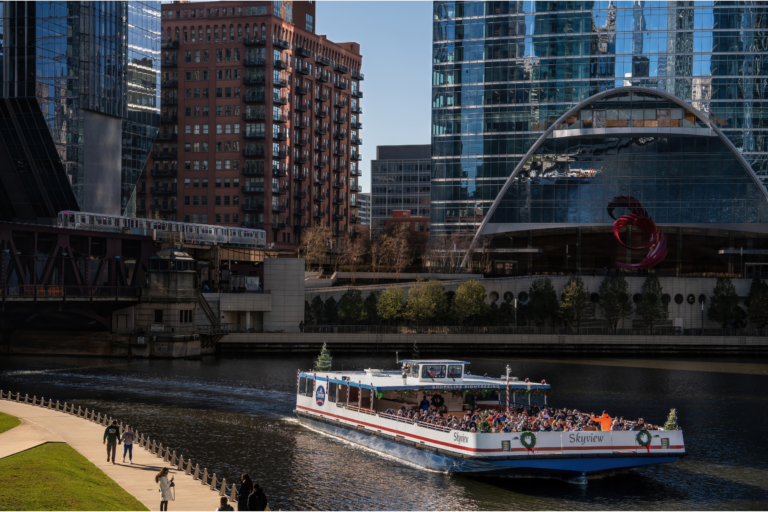
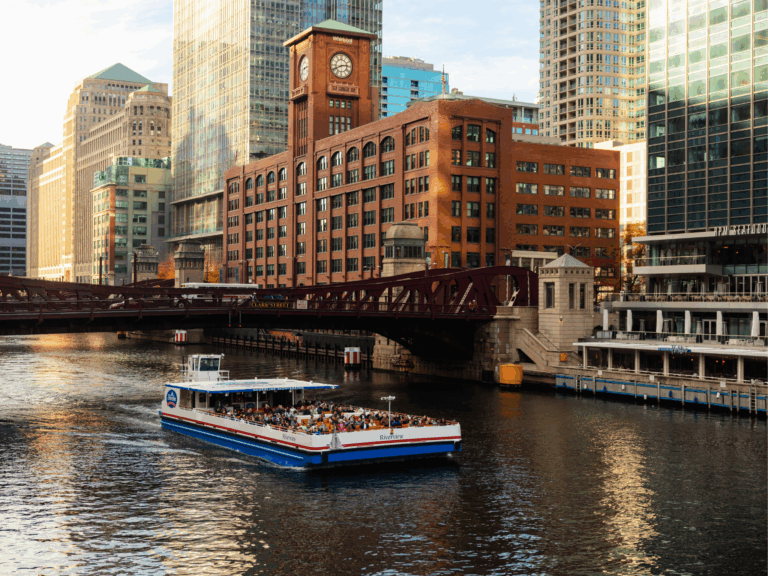
Chicago is filled with famous landmarks, but some of the city’s most recognizable buildings and attractions look completely different when you see them from the river or Lake Michigan. From the water, familiar places feel larger, more detailed, and more connected to the city around them.
That is one reason a Chicago boat tour is such a memorable way to sightsee. Instead of seeing each landmark from a sidewalk, bridge, or observation deck, you get a moving view that changes as you cruise through downtown or along the lakefront.
Whether you are interested in Chicago architecture, skyline views, or classic sightseeing, these landmarks show why the city is often best experienced from the water.
What Chicago Landmarks Can You See from the Water?
Some of the best Chicago landmarks to see from the water include the Wrigley Building, Tribune Tower, Marina City, Merchandise Mart, Wolf Point, 150 N. Riverside, Aqua, St. Regis Chicago, and Navy Pier. River tours are best for close-up architecture, while lake tours are best for skyline views and Navy Pier. Visitors who want to experience the Chicago Harbor Lock can do so on our Chicago History Tour.
From the water, buildings that feel crowded from the street become easier to understand. Attractions that feel busy on land, like Navy Pier, become part of a much larger lakefront scene. The city’s bridges, towers, and waterfront spaces start to feel connected instead of separate.
That shift in perspective is what makes a Chicago architecture river tour and other sightseeing cruises so valuable for visitors and locals alike.
| Landmark | Best Seen From | Why It Looks Different from the Water |
|---|---|---|
| Wrigley Building | Chicago River | Its clock tower, white terra cotta, and riverfront placement create a gateway view near Michigan Avenue. |
| Tribune Tower | Chicago River | Its Gothic details and vertical shape are easier to compare against nearby modern towers. |
| Marina City | Chicago River | The towers, parking decks, balconies, and marina read as one complete riverfront complex. |
| Merchandise Mart | Chicago River | Its full Art Deco scale is easier to understand from the riverfront. |
| Wolf Point | Chicago River | The meeting point of the river branches is clearest from the water. |
| 150 N. Riverside | Chicago River | Its narrow base and engineering constraints are more visible from below. |
| Aqua and St. Regis Chicago | River and lakefront views | Their modern forms help show how Chicago’s skyline continues to evolve. |
| Navy Pier | Lake Michigan | Its size, position, and connection to the skyline are clearer from the lake. |
| Chicago Harbor Lock | Lake and River Chicago History Tour | The transition between river and lake becomes an active part of the sightseeing experience. |
1. Wrigley Building
From the river, the Wrigley Building becomes part of a larger gateway view at Michigan Avenue. Its clock tower, white terra cotta, and riverfront placement are easier to take in at once from the water than from the sidewalk.
The building stands out against the darker glass, steel, and stone structures nearby. From a boat, its shape and position feel more intentional because you can see how it anchors one of the most recognizable stretches of the Chicago River.
The Wrigley Building also works well as an introduction to Chicago architecture because it shows how design, location, and civic identity come together along the riverfront.
2. Tribune Tower
Tribune Tower is another Michigan Avenue landmark that changes when viewed from the water. On the sidewalk, visitors often focus on the Gothic details and historic exterior. From the river, the full vertical shape of the tower becomes more noticeable, especially in relation to the Wrigley Building, Michigan Avenue, and the surrounding skyline.
Its ornate design contrasts with many of the modern buildings nearby. That contrast is easier to see from the river, where several architectural styles appear in the same view.
For anyone interested in Chicago landmarks, Tribune Tower is a strong example of why the city’s architecture is more powerful when seen as part of the riverfront, not just as individual buildings.
3. Marina City
Marina City is one of the clearest examples of a Chicago landmark that looks different from the water. The twin towers are famous for their rounded “corncob” shape, but the river view helps explain why the complex was designed as a city within a city.
From the water, you can see the towers, parking levels, balconies, and marina together. That makes the design feel more complete than it does from the street, where you may only see the towers from one angle.
Marina City also shows how Chicago’s riverfront changed over time. What was once a heavily industrial downtown area became a place where people could live, work, park, dock boats, and spend time near the river. From the river, that story is much easier to understand because you are seeing the building from the water it was designed around.
4. Merchandise Mart
The Merchandise Mart is impressive from any angle, but its scale is most obvious from the river. From the street, the building can feel like a long city block. From the water, it reads as one massive Art Deco landmark stretching along the riverfront.
Its size is part of what makes it memorable. The building was originally constructed as a wholesale warehouse, and its broad footprint reflects Chicago’s history as a center of trade, transportation, and commerce.
From a boat, you can better see the building’s relationship to the river. It does not just sit in downtown Chicago. It occupies a major section of the riverfront, which makes its size and presence much easier to appreciate.
5. Wolf Point
Wolf Point is not a single building, but it is one of the most important places to see from the water. It is where the main, north, and south branches of the Chicago River meet. From land, it can be hard to understand the significance of that location. From the river, it becomes immediately clear.
This is one of the places where Chicago’s history and modern skyline meet. Wolf Point was an early center of development for the city, and today it is surrounded by contemporary towers and riverfront spaces.
A boat gives you the right vantage point to understand why this location mattered historically and why it still shapes the city visually. It is also one of the best spots to see how the river organizes downtown Chicago.
6. 150 N. Riverside
150 N. Riverside is one of the most dramatic modern buildings to see from the river. Its narrow base makes the tower look almost impossible from certain angles, especially when you are close to it on the water.
From the street, the engineering can be difficult to fully understand. From the river, the building’s unusual structure becomes much clearer. You can see how the tower responds to a tight site, nearby rail lines, and the need to preserve space along the riverfront.
This is the kind of building that makes an architecture-focused river tour especially interesting. The view is not just beautiful. It helps explain how architects and engineers solve complicated problems in a dense downtown setting.
7. Aqua and St. Regis Chicago
Aqua and St. Regis Chicago are two modern landmarks that show how Chicago’s skyline continues to evolve. Both are associated with Studio Gang and Jeanne Gang, and both are especially interesting from the water because their forms change as your angle changes.
Aqua is known for its flowing balconies, which can appear to ripple from a distance. From the water, those curves become more visible across the full height of the building, making it feel connected to the movement of the river and lake nearby.
St. Regis Chicago has a stacked, tapering form that stands out from both river and lakefront views. From the water, its relationship to the surrounding skyline becomes clearer, especially near the point where downtown meets the lakefront.
Together, these buildings help connect classic Chicago architecture with the city’s newer generation of skyline-defining towers.
8. Navy Pier
Navy Pier is one of Chicago’s most visited attractions, but it feels very different when viewed from the water. On land, it can feel busy, crowded, and activity-filled. From Lake Michigan, it becomes part of the wider lakefront and skyline.
From a boat, you can see Navy Pier’s length, its position along the lake, and how it connects to downtown Chicago. The Centennial Wheel, pier buildings, boats, and lakefront all become part of one view.
This is why a Lake Michigan boat tour is such a good way to appreciate Navy Pier. Instead of experiencing it only as a destination, you see it as one of the defining features of Chicago’s waterfront.
If you are planning to spend time there before or after your cruise, it is easy to pair a tour with nearby restaurants, lakefront attractions, and other things to do near Navy Pier.
Bonus: Chicago Harbor Lock
The Chicago Harbor Lock may not be a landmark in the same way as a famous skyscraper, but it is one of the most interesting parts of Shoreline’s Chicago History Tour. The lock connects the Chicago River to Lake Michigan and helps manage the difference in water levels between the river and the lake.
For many visitors, passing through the lock is one of the most memorable parts of the Lake and River History Tour because it turns Chicago’s engineering history into something you can actually experience from the boat. It also helps explain the city’s relationship with water, including the river, lake, transportation systems, and flood-control infrastructure.
Because our other tours do not use the lock, visitors who want to experience this part of Chicago’s waterfront should choose the Chicago History Tour. This tour connects river views, lakefront scenery, and Chicago history in one route.
Is the Chicago River or Lake Michigan Better for Seeing Landmarks?
The Chicago River is better for close-up architecture and riverfront landmarks. Lake Michigan is better for wide skyline views, Navy Pier, and seeing how the city fits along the waterfront. The best choice depends on whether you want detail or scale.
A river tour brings you close to buildings like the Wrigley Building, Tribune Tower, Marina City, Merchandise Mart, Wolf Point, and 150 N. Riverside. You can see architectural details, bridges, and how each building relates to the river.
A lake tour gives you a broader view. From Lake Michigan, the skyline opens up, and landmarks like Navy Pier, Lake Point Tower, and the downtown skyline become easier to see as part of one continuous waterfront.
If you are deciding between the two, compare Chicago river and Lake Michigan boat tours based on the landmarks, views, and type of sightseeing experience you want.
Why Do Chicago Landmarks Look Different from a Boat?
Chicago landmarks look different from a boat because the water changes your angle, distance, and sense of scale. From the river, you can look up at buildings without the visual clutter of traffic, sidewalks, and surrounding streets. From the lake, you can see the skyline as one complete view.
The moving perspective also matters. A boat tour does not show you one fixed view. It gives you a sequence of views as buildings appear, shift, and recede along the route. That makes familiar landmarks feel more dynamic.
For architecture, this is especially valuable. Chicago’s buildings were not designed only to be seen from one corner or one sidewalk. Many of them were shaped by the river, rail lines, lakefront, bridges, and the city grid. Seeing them from the water helps reveal those relationships.
What is the Best Way to See Chicago Landmarks from the Water?
The best way to see Chicago landmarks from the water is to choose a boat tour based on the type of views you want. For architecture and riverfront landmarks, choose a Chicago architecture river tour. For skyline views and Navy Pier, choose a Lake Michigan boat tour. For both river and lake perspectives, choose a tour that includes both waterways. For the Chicago Harbor Lock specifically, choose the Chicago History Tour
A Chicago sightseeing cruise can also help you cover more of the city in less time. Instead of moving from landmark to landmark on foot, you can see a series of buildings, bridges, and waterfront views in one route.
That is what makes Chicago boat tours so useful for visitors. They are scenic, efficient, and built around the views that make the city memorable.
Which Shoreline Sightseeing Tour is Best for Seeing Chicago Landmarks?
The best Shoreline tour for seeing Chicago landmarks depends on whether you want riverfront architecture, skyline views, or a route that connects the river and lake. Each tour highlights a different side of the city.
| Tour | Best For | Landmarks and Views |
|---|---|---|
| Architecture River Tour | Close-up Chicago architecture and riverfront landmarks | Wrigley Building, Tribune Tower, Marina City, Merchandise Mart, Wolf Point, 150 N. Riverside, bridges, and riverfront towers |
| Skyline Lake Tour | Open-water skyline views and Navy Pier | Navy Pier, Lake Michigan, lakefront scenery, and the full Chicago skyline |
| Lake and River Chicago History Tour | A combined river, lake, and history experience | Chicago River, Lake Michigan, Chicago Harbor Lock, skyline views, and waterfront history |
If you are most interested in architecture, start with the river. If you want skyline photos, choose the lake. If you want a broader story of Chicago’s relationship with the river and Lake Michigan, choose a tour that includes both.
Plan a Chicago Boat Tour Around the City’s Best Landmarks
Chicago’s landmarks are worth seeing from the street, but the water adds something different. It reveals the scale of the buildings, the shape of the skyline, and the way the river and lake define the city.
Whether you want to see classic architecture along the river, modern skyscrapers near Wolf Point, Navy Pier from Lake Michigan, or the skyline from open water, Shoreline Sightseeing offers several ways to experience Chicago’s landmarks from a better angle.
Choose the tour that matches the views you want and see why some of Chicago’s most familiar places feel completely different from the water.
FAQs About Seeing Chicago Landmarks from the Water
On a Chicago river tour, you may see landmarks such as the Wrigley Building, Tribune Tower, Marina City, Merchandise Mart, Wolf Point, 150 N. Riverside, and several riverfront towers. On a Lake Michigan tour, you may see Navy Pier, the Chicago skyline, lakefront landmarks, and open-water views of downtown.
On a Chicago architecture tour, you can see a variety of historic and modern buildings along the Chicago River. Common highlights include the Wrigley Building, Tribune Tower, Marina City, Merchandise Mart, 150 N. Riverside, Aqua, St. Regis Chicago, and several other riverfront towers.
Yes. A boat tour is one of the best ways to see Chicago landmarks because it gives you clear views from the river or lake without the traffic, crowds, and limited sightlines of street-level sightseeing.
Yes. You can see Navy Pier from many Lake Michigan boat tours. From the water, Navy Pier appears as part of the wider lakefront and skyline, making it easier to understand its size, location, and relationship to downtown Chicago.
The Chicago River is better for close-up architecture and historic riverfront landmarks. Lake Michigan is better for skyline views, Navy Pier, and open-water scenery. Many visitors choose based on whether they want architectural detail or a wider view of the city.
A Chicago architecture river tour is the best option if you want to focus on architecture. The river gives you close-up views of buildings, bridges, and downtown landmarks that are difficult to fully appreciate from the street.
Chicago buildings look different from the river because you can see their full height, riverfront placement, and relationship to nearby bridges and buildings. The river also removes many street-level distractions, making the architecture easier to view and understand.
One of the best ways to see the Chicago skyline is from Lake Michigan. A lake tour gives you enough distance to see the full skyline, while a river tour gives you close-up views of the buildings that shape it.