Summary
Chicago's architecture is famous because the Great Chicago Fire of 1871 cleared the way for a wave of experimental, high-rise construction, making the city the birthplace of the modern skyscraper. That rebuilding period produced the Chicago School of architecture, followed by later movements like Art Deco and the International Style, giving the city one of the most varied and influential skylines in the world.
Table of Contents
- Why is Chicago Known for Architecture?
- The Great Chicago Fire and the Birth of the Skyscraper
- The Chicago School: “Form Follows Function”
- Chicago’s Major Architectural Styles
- Famous Chicago Architects
- Famous Chicago Buildings and Landmarks
- How Many Skyscrapers Does Chicago Have?
- What Are Chicago’s Oldest Buildings?
- Why See Chicago’s Architecture From the River?
- What to Expect on a Chicago Architecture Boat Tour
- See Chicago’s Architecture for Yourself
- FAQs About Chicago’s Architecture
Chicago’s architecture isn’t famous by accident. The city is where the modern skyscraper was born, where entire design movements took shape, and where some of the most influential architects in American history built their careers. Few cities anywhere pack this much architectural history into one downtown skyline.
Quick answer: Chicago’s architecture is famous because the Great Chicago Fire of 1871 cleared the way for a wave of experimental, high-rise construction, making the city the birthplace of the modern skyscraper. That rebuilding period produced the Chicago School of architecture, followed by later movements like Art Deco and the International Style, giving the city one of the most varied and influential skylines in the world.
Here’s a closer look at the history, styles, and buildings behind Chicago’s reputation, and why a Chicago architecture river cruise with Shoreline Sightseeing is one of the clearest ways to actually see it.
Why is Chicago Known for Architecture?
Chicago is known for architecture because it’s widely credited as the birthplace of the modern skyscraper, a title that traces back to the aftermath of a single disaster. After the Great Chicago Fire of 1871 destroyed much of the city’s wooden downtown, architects and engineers rebuilt it almost from scratch, using new materials and techniques that hadn’t been tested at this scale before.
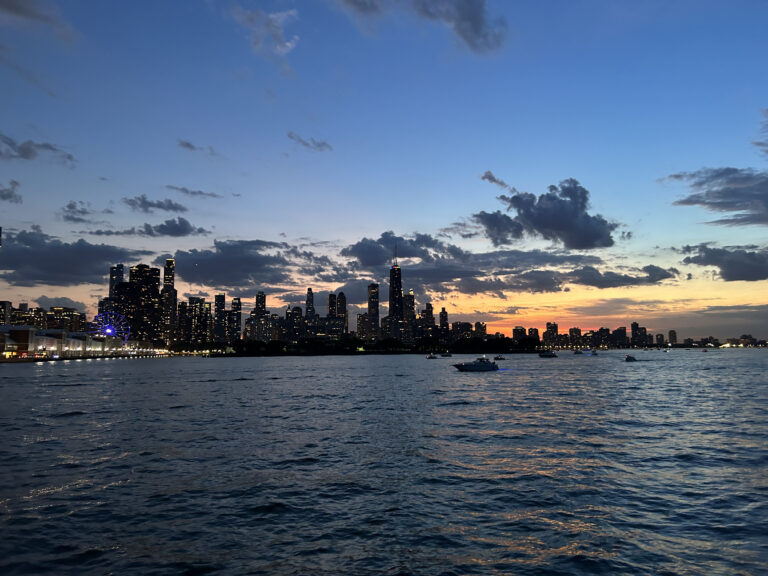
That period of rebuilding gave Chicago something most cities never get: a downtown built largely within a few decades, by architects actively inventing new ways to build taller, safer, and more efficient structures. The result is a skyline that reads like a timeline of architectural innovation, rather than a single style repeated block after block.
The Great Chicago Fire and the Birth of the Skyscraper
The Great Chicago Fire of 1871 destroyed roughly three and a half square miles of the city, including most of its downtown. While devastating, the fire also cleared space for architects to rebuild with new steel-frame construction techniques rather than the wood-frame buildings that had fueled the blaze.
Steel framing allowed buildings to support far more weight and height than traditional masonry construction, which is what made the skyscraper possible in the first place. Combined with the invention of the safety elevator, Chicago’s architects were suddenly able to build taller than almost anywhere else in the world, and they did.
The Chicago School: “Form Follows Function”
The Chicago School is the name given to the group of architects who rebuilt downtown Chicago after the fire, including Louis Sullivan, Daniel Burnham, John Root, William Holabird, and William Le Baron Jenney. Their work is often summarized by Sullivan’s famous principle, “form follows function,” the idea that a building’s design should reflect its purpose rather than imitate older, purely decorative styles.
This philosophy became the foundation of modern American commercial architecture and is a major reason Chicago is still studied as a starting point for skyscraper design today.
Chicago’s Major Architectural Styles
Chicago’s skyline isn’t the product of one architectural style. It’s a layered mix of movements, each tied to a different era of the city’s growth.
| Style | Era | What to Look For |
|---|---|---|
| Chicago School | Late 1800s, post-fire | Steel-frame construction, large windows, minimal ornamentation, function-first design |
| Prairie School | Early 1900s | Horizontal lines, low-pitched roofs, integration with the surrounding landscape |
| Art Deco | 1920s to 1930s | Bold geometric detailing, verticality, and ornamental crowns on buildings like Tribune Tower |
| Second Chicago School / International Style | Mid-1900s | Glass and steel towers with minimal ornamentation, led by Mies van der Rohe |
| Postmodern and Contemporary | 1980s to today | Experimental shapes, glass curtain walls, and buildings like the Thompson Center and Aqua Tower |
Famous Chicago Architects
Chicago’s architectural reputation is closely tied to the individual architects who shaped it, several of whom are still studied in architecture programs worldwide.
Louis Sullivan
Often called the father of the skyscraper, Sullivan helped define the Chicago School and mentored a young Frank Lloyd Wright early in his career.
Frank Lloyd Wright
Wright went on to develop the Prairie School style, though much of his most famous residential work sits in Chicago’s surrounding suburbs rather than downtown. He also later redesigned the lobby of the Rookery, one of the Chicago School’s earliest surviving buildings.
Daniel Burnham
Burnham helped lead the post-fire rebuilding and later designed the 1893 World’s Columbian Exposition, which brought international attention to Chicago’s architecture and urban planning.
Ludwig Mies van der Rohe
Mies led the Second Chicago School in the mid-20th century, bringing the glass-and-steel International Style to buildings across downtown, including the twin towers at 860–880 Lake Shore Drive, considered a defining example of the style.
Jeanne Gang
More recently, architects like Gang have continued Chicago’s reputation for architectural experimentation, designing contemporary landmarks such as Aqua Tower.
Famous Chicago Buildings and Landmarks
Some of Chicago’s most recognizable buildings double as a walkthrough of the city’s architectural history.
Willis Tower
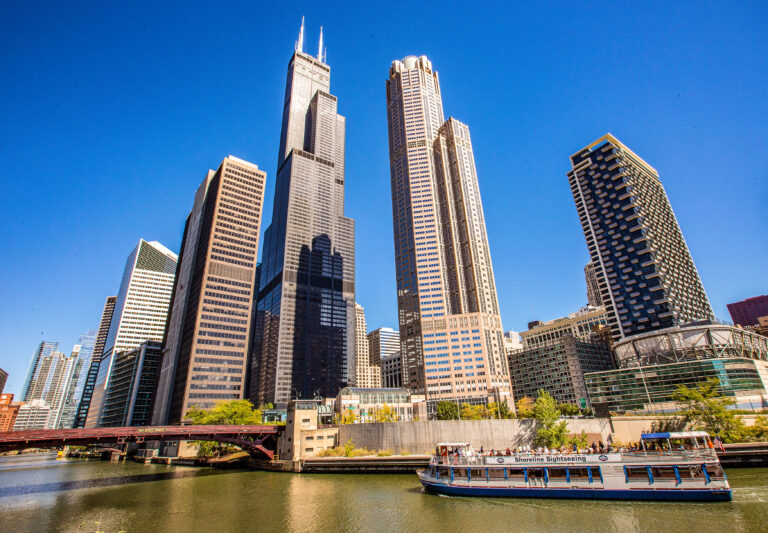
Completed in 1973, Willis Tower held the title of world’s tallest building for nearly 25 years and remains one of the most recognized skyscrapers on the skyline.
Marina City
With its distinctive corncob-shaped towers, Marina City is a Chicago River landmark and one of the most photographed buildings from the water.
The Wrigley Building and Tribune Tower
These two buildings sit across from each other along Michigan Avenue, representing the ornamental, historically-influenced architecture of the early 20th century.
The Rookery
In the Loop, the Rookery is one of the oldest surviving high-rises from the Chicago School era, with a lobby later redesigned by Frank Lloyd Wright.
The Thompson Center
Designed by Helmut Jahn and originally opened in 1985 as the State of Illinois Center, the Thompson Center is one of the city’s most distinctive Postmodern buildings. It’s currently undergoing a major renovation ahead of a planned move-in by its new occupant, expected to wrap up in the next year or so.
How Many Skyscrapers Does Chicago Have?
Chicago is home to hundreds of skyscrapers, with dozens rising above 500 feet, more high-rises than almost any other American city outside of New York. That density is a direct result of the post-fire rebuilding boom and the decades of architectural competition that followed it, and it’s part of why a single river tour can pass more landmark buildings in an hour than most cities have downtown.
What Are Chicago’s Oldest Buildings?
Chicago’s oldest surviving buildings mostly date to the years immediately following the Great Chicago Fire, since so little of the city’s earlier wood-frame construction survived. The Rookery (1888), the Chicago Board of Trade Building, and the Monadnock Building are among the structures still standing from this early skyscraper era, with the Monadnock in particular marking the transition point between heavy masonry construction and the steel-frame technique that would define everything built after it.
Why See Chicago’s Architecture From the River?
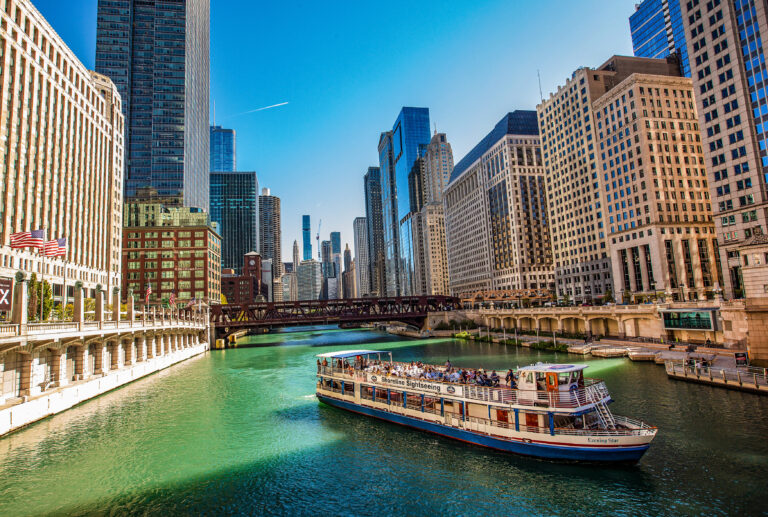
Chicago’s most significant architecture is concentrated along the Chicago River, which isn’t a coincidence. The river was the city’s original industrial artery, and many of its landmark buildings were designed with river-facing facades in mind, meaning a large part of Chicago’s architectural story is genuinely built to be seen from the water.
Seeing these buildings from a bridge or the sidewalk only shows part of the picture. From the river, the scale, spacing, and relationship between buildings becomes much easier to understand, especially for first-time visitors trying to piece together a century and a half of architectural history in a single afternoon.
What to Expect on a Chicago Architecture Boat Tour
A guided Chicago architecture boat tour gives first-time visitors context that’s difficult to get from a self-guided walk. Rather than passing buildings without knowing their history, guests hear the story behind each landmark as the boat moves along the Main Stem and into the North and South Branches, why Marina City is nicknamed the “corncobs,” which lobby Frank Lloyd Wright redesigned, or what made the Rookery’s construction so different from the buildings that came before it.
This kind of narration matters most for visitors who aren’t already familiar with names like the Chicago School, the Rookery, or Mies van der Rohe. A guide connects those names to the actual buildings in view, turning a scenic ride into a genuine architecture lesson. If you’re deciding how much time to set aside, it’s worth knowing how long the tour runs before you plan the rest of your day around it.
See Chicago’s Architecture for Yourself
Chicago’s architecture is famous for a reason: a devastating fire, a wave of architectural experimentation, and more than a century of building on top of that legacy. Understanding the history is one thing, but seeing it in person, from the water, is what makes it click.
Ready to see it firsthand? Book a Chicago architecture river tour with Shoreline Sightseeing and see the Chicago School, Art Deco, and modern skyline the way the city’s own architects intended it to be seen.
FAQs About Chicago’s Architecture
Chicago’s architecture is famous because the city is widely credited as the birthplace of the modern skyscraper, a legacy that began after the Great Chicago Fire of 1871 cleared the way for new steel-frame construction techniques.
Chicago is known for architecture because of its role in developing the modern skyscraper, along with a series of influential architectural movements, including the Chicago School, Prairie School, Art Deco, and the International Style.
The Chicago School refers to the group of architects who rebuilt downtown Chicago after the 1871 fire, known for pioneering steel-frame skyscraper construction and the principle that “form follows function.”
Some of the most famous Chicago architects include Louis Sullivan, Daniel Burnham, Frank Lloyd Wright, and Ludwig Mies van der Rohe, along with contemporary architects like Jeanne Gang.
Chicago’s main architectural styles include the Chicago School, Prairie School, Art Deco, the International Style (Second Chicago School), and contemporary Postmodern design.
Chicago is home to hundreds of skyscrapers, with dozens rising above 500 feet, giving it one of the largest skyscraper skylines in the United States.
Chicago’s oldest surviving buildings, including the Rookery, the Chicago Board of Trade Building, and the Monadnock Building, mostly date to the years just after the Great Chicago Fire of 1871.
Some of Chicago’s most iconic buildings include Willis Tower, Marina City, the Wrigley Building, Tribune Tower, and the Rookery.
Many of Chicago’s landmark buildings were designed with river-facing facades, so seeing them from the water shows the scale and relationship between buildings more clearly than a view from the street.
A Chicago architecture boat tour is a guided cruise along the Chicago River that highlights the city’s landmark buildings, bridges, and architectural history, with narration explaining the story behind each landmark.
Yes. A guided river cruise gives first-time visitors context about Chicago’s architecture and history that’s difficult to get from a self-guided walk, making it a strong introduction to the city.