Summary
The Chicago River is the river running through downtown Chicago, splitting into a North Branch, a South Branch, and a Main Stem that connects to Lake Michigan. The river's depth in the downtown channel generally runs 20 to 26 feet, maintained to support boat traffic. In 1900, engineers reversed its natural flow so the river now moves away from the lake, eventually reaching the Mississippi River instead.
Table of Contents
- What River Runs Through Chicago?
- The Three Branches of the Chicago River
- How Deep is the Chicago River?
- The Chicago River Reversal: One of America’s Great Engineering Feats
- Does the Chicago River Reverse Flow?
- Which Way Does the Chicago River Flow Today?
- Where Does the Chicago River Meet Lake Michigan?
- Why is the Chicago River Dyed Green?
- Is the Chicago River Ever Dyed Other Colors?
- Is the Chicago River Still Green?
- Are There Fish in the Chicago River?
- Chicago River Architecture and Bridges
- See the Chicago River for Yourself
- FAQs About the Chicago River
The river running through downtown Chicago is the Chicago River, a defining feature of the city’s geography, history, and skyline. It splits into three branches, was famously reversed over a century ago, and still shapes how the city looks and moves today.
Quick answer: The Chicago River runs through downtown Chicago, splitting into a North Branch, a South Branch, and a Main Stem that connects to Lake Michigan. The river’s depth in the downtown channel generally runs 20 to 26 feet, maintained to support boat traffic. In 1900, engineers reversed its natural flow so the river now moves away from the lake, eventually reaching the Mississippi River instead.
Here’s a closer look at the Chicago River: what it’s called, how deep it runs, why it was reversed, and how to see it from a Chicago river tour.
What River Runs Through Chicago?
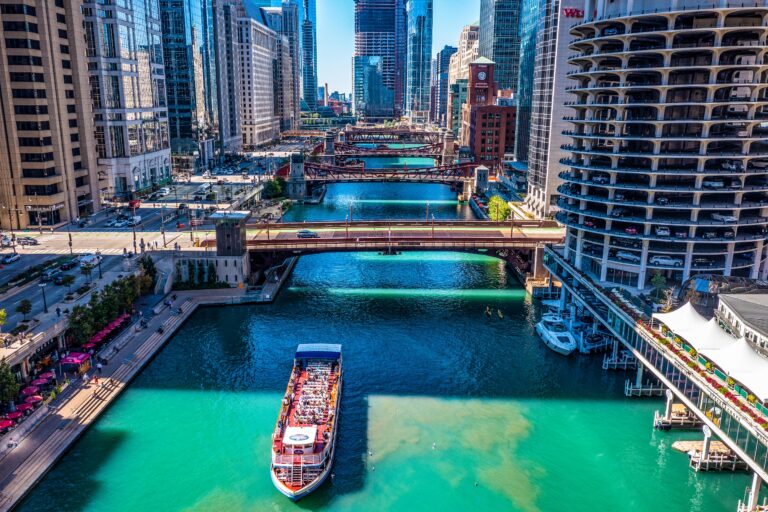
The Chicago River is the river that runs through downtown Chicago. It flows through the heart of the city in three connected sections: the North Branch, the South Branch, and the Main Stem, which meets Lake Michigan near Navy Pier and Michigan Avenue.
The river is often described in the plural, “the Chicago rivers” or “rivers of Chicago,” because its branches split well before they meet downtown, giving the city three distinct waterways that eventually join into one.
The Three Branches of the Chicago River
The Chicago River is made up of three branches, each with its own character and role in the city.
| Branch | Location | What You’ll See |
|---|---|---|
| Main Stem | Downtown, connecting to Lake Michigan | The skyline, major bridges, and the river’s busiest architecture stretch |
| North Branch | Runs north from downtown | Industrial corridors, neighborhoods, and newer riverfront development |
| South Branch | Runs south and west from downtown | The route into the Sanitary and Ship Canal, connecting toward the Mississippi |
Reading about the three branches is one thing, seeing how they actually connect is another. On our Architecture River Tour, guests travel the Main Stem and into both branches, watching the skyline give way to bridges, industrial corridors, and riverfront architecture that isn’t visible from any single point on land.
How Deep is the Chicago River?
The Chicago River generally runs 20 to 26 feet deep through the downtown channel, though depth varies by stretch and season. The river is maintained at this depth to support commercial barge traffic, tour boats, and other vessels that rely on the waterway daily.
Depth tends to be greatest in the Main Stem downtown, where boat traffic is heaviest, and can be shallower in stretches further from the city center.
The Chicago River Reversal: One of America’s Great Engineering Feats
In 1900, engineers permanently reversed the flow of the Chicago River, one of the largest civil engineering achievements of its era. Instead of flowing east into Lake Michigan, the river was redirected to flow inland, a project that took years to plan and build.
The reversal was accomplished by constructing the Chicago Sanitary and Ship Canal, a roughly 28-mile channel connecting the river to the Des Plaines and Illinois Rivers. At the time, city leaders needed a way to protect Chicago’s drinking water supply, which was drawn from the same lake the river emptied into. Reversing the river’s course solved that problem by sending its flow away from the lake instead.
When the canal opened in January 1900, the river’s direction changed for good. The project remains one of the most ambitious water engineering feats in American history, and it permanently changed the shape of the city’s waterways.
Does the Chicago River Reverse Flow?
Yes. The Chicago River’s flow was permanently reversed in 1900 and continues to flow in the reversed direction today, away from Lake Michigan rather than into it. This isn’t a temporary or seasonal reversal, it’s the river’s ongoing, engineered direction.
Which Way Does the Chicago River Flow Today?
Today, the Chicago River flows inland, away from Lake Michigan, through the South Branch and into the Chicago Sanitary and Ship Canal. From there, it connects to the Des Plaines River, then the Illinois River, eventually reaching the Mississippi River.
This means that, unlike most rivers that empty into a nearby larger body of water, the Chicago River technically sends its water hundreds of miles inland rather than out into Lake Michigan.
Where Does the Chicago River Meet Lake Michigan?
The Chicago River meets Lake Michigan downtown, near Navy Pier and the mouth of the river by Lake Point Tower. This is also where the Chicago Harbor Lock is located, a structure that manages the difference in water levels between the river and the lake.
The Harbor Lock is a specific feature of Shoreline Sightseeing’s Lake and River Chicago History Tour, which travels through it as part of the route connecting the river and the lake.
Why is the Chicago River Dyed Green?
The Chicago River is dyed green each year as part of Chicago’s St. Patrick’s Day tradition, a practice that dates back to 1962. The tradition started after members of the Chicago Journeymen Plumbers Local 130 noticed that a leak-detection dye had turned a colleague’s overalls bright green, which inspired the idea of dyeing the entire river for the holiday.
The first dyeing used around 100 pounds of dye and kept the river green for about a week. In 1966, the city switched to a vegetable-based dye after environmental concerns about the original formula. Today, the same union still handles the dyeing each year, using around 40 pounds of a closely guarded, food-grade dye that keeps the river green for just a few hours before fading back to normal.
Is the Chicago River Ever Dyed Other Colors?
Occasionally. While green is the river’s signature St. Patrick’s Day color, Chicago has dyed the river for other major civic occasions. The most notable example came in 2016, when the city dyed the river blue to celebrate the Chicago Cubs’ World Series win, using the same plumbers’ union and a similar process to the annual green dyeing.
These one-off dyeing events are tied to specific celebrations rather than a recurring schedule, so the river’s color outside of St. Patrick’s Day and rare civic moments like this is its normal, everyday color.
Is the Chicago River Still Green?
No, not year-round. The Chicago River is only dyed green for a few hours around St. Patrick’s Day each year, not on a permanent or ongoing basis. Outside of that yearly event, the river returns to its usual color.
Are There Fish in the Chicago River?
Yes, and the recovery has been dramatic. In the 1970s, fewer than 10 fish species were found in the Chicago River due to decades of pollution. Today, more than 70 species live in the river system, according to monitoring by the Metropolitan Water Reclamation District and Friends of the Chicago River.
A 2025 study by Shedd Aquarium researchers found that at least two dozen fish species, including largemouth bass, bluegill, and black crappie, are now successfully spawning in the river itself, a sign that the river isn’t just passing through fish, but supporting them through their full life cycle.
Chicago River Architecture and Bridges
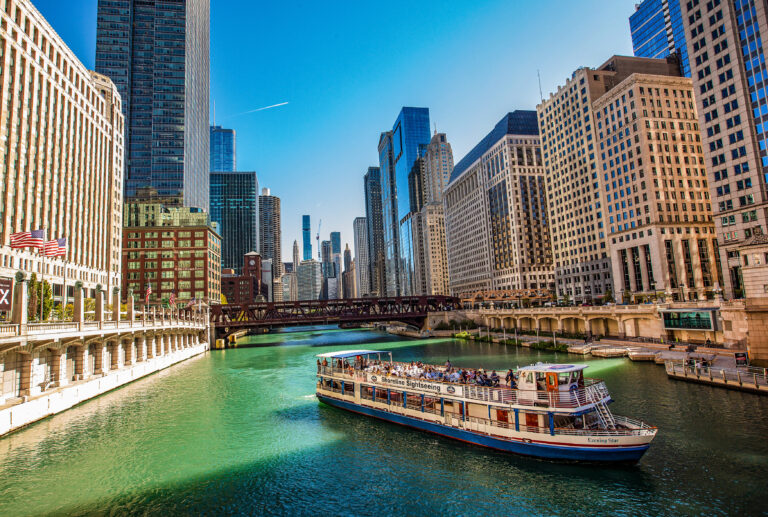
The Chicago River is lined with some of the city’s most recognizable architecture, along with dozens of movable bridges that lift or swing open to let boats pass through. Many of these bridges date back over a century and remain part of the working infrastructure that keeps the river navigable today, one of several reasons familiar landmarks look different once you’re on the river.
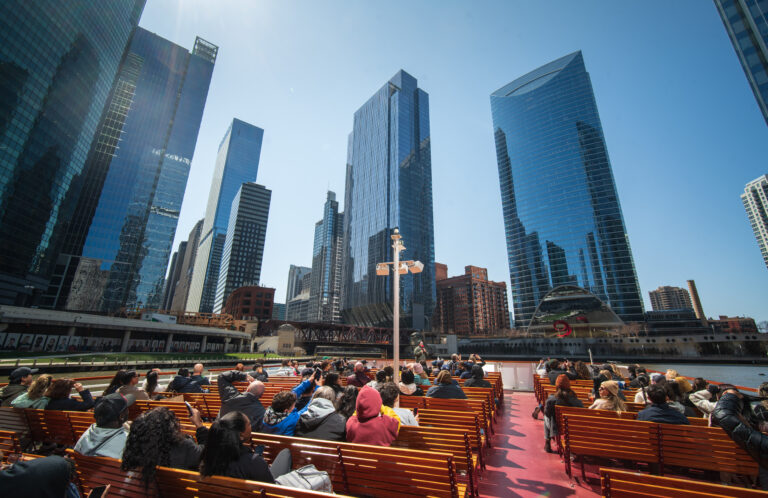
This combination of historic engineering and modern skyline is a large part of what makes the river worth seeing up close rather than just from a bridge or the Riverwalk. From the water, bridges that look identical from the sidewalk reveal different mechanisms, ages, and stories, the kind of detail that guides on Shoreline’s Architecture River Tour walk through as the boat passes along the Main Stem and both branches, a 75-minute experience that covers most of what this post describes firsthand.
See the Chicago River for Yourself
The Chicago River’s name, depth, reversal, and branches are only part of the story. Seeing the river in person, from the water instead of a bridge or sidewalk, gives a much clearer sense of how the city grew up around it. If you’re also weighing a river tour against a lake tour, the two show very different sides of the city.
Ready to experience it firsthand? A river tour is one of the clearest ways to answer that question yourself, and it’s worth knowing what to expect before you go. Book a Chicago river cruise with Shoreline Sightseeing and see the Main Stem, North Branch, and South Branch the way the city’s engineers and architects intended.
FAQs About the Chicago River
The Chicago River runs through downtown Chicago, splitting into a North Branch, a South Branch, and a Main Stem that connects to Lake Michigan.
The Chicago River generally runs 20 to 26 feet deep through the downtown channel, maintained to support boat traffic. Depth can vary by stretch and season.
The Chicago River was reversed in 1900 to protect the city’s drinking water supply, which was drawn from Lake Michigan. Engineers built the Chicago Sanitary and Ship Canal to redirect the river’s flow inland instead.
Yes. The river’s flow was permanently reversed in 1900 and continues to flow in that reversed direction today, away from Lake Michigan.
The Chicago River flows away from Lake Michigan, through the South Branch and the Chicago Sanitary and Ship Canal, eventually reaching the Illinois River and the Mississippi River.
No, not anymore. Since the 1900 reversal, the Chicago River flows inland, away from Lake Michigan, rather than into it.
The Chicago River is made up of the Main Stem, the North Branch, and the South Branch, which connect downtown before flowing toward the Sanitary and Ship Canal.
The Chicago River is dyed green each year for St. Patrick’s Day, a tradition started in 1962 by the Chicago Journeymen Plumbers Local 130.
Occasionally. The most notable example is 2016, when the city dyed the river blue to celebrate the Chicago Cubs’ World Series win. These events are tied to specific celebrations, not a regular schedule.
No. The river is only dyed green for a few hours around St. Patrick’s Day each year, not on a permanent basis.
Since 1966, the city has used a vegetable-based, food-grade dye to color the river green, replacing the original chemical dye used in the early 1960s.
Yes. Fewer than 10 fish species lived in the river in the 1970s. Today, more than 70 species live in the Chicago River system, and at least two dozen are known to successfully spawn there.
The Chicago River’s Main Stem and branches run several miles through the city, connecting to the roughly 28-mile Chicago Sanitary and Ship Canal that carries the reversed flow toward the Mississippi River system.
The Chicago River meets Lake Michigan downtown, near Navy Pier and the Chicago Harbor Lock, which manages the water level difference between the river and the lake.
Yes. Chicago river tours, including Shoreline’s Architecture River Tour, travel along the Main Stem and branches, showing the city’s architecture, bridges, and history from the water.